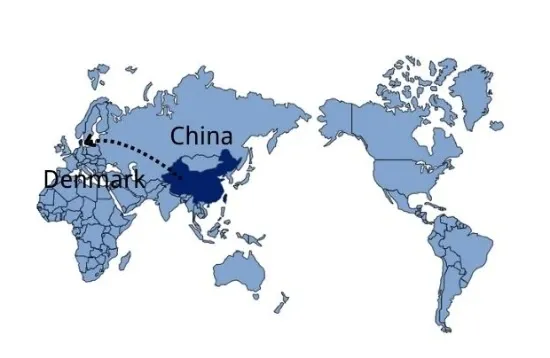
Shipping from China to Denmark is a short sea leg bolted onto a long one. The vessel crosses the Suez Canal toward northern Europe, and your container then either calls Aarhus directly or is fed from Hamburg, Rotterdam or Gdansk on a smaller ship. That relay is where transit windows stretch, and it is also where most first-time importers discover that Danish VAT is 25 percent — the highest standard rate in the EU.
This guide is written from the operating side of the lane: how sea, rail and air freight from China to Denmark is priced, which ports and airports actually work, what duty and Danish VAT cost on a real shipment, how EORI and producer responsibility registrations gate your first sale, and where importers most often lose money. Denmark is a small market with a dense, well-organised logistics sector, which means the freight is rarely the problem — the paperwork is.
Sea Freight From China to Denmark
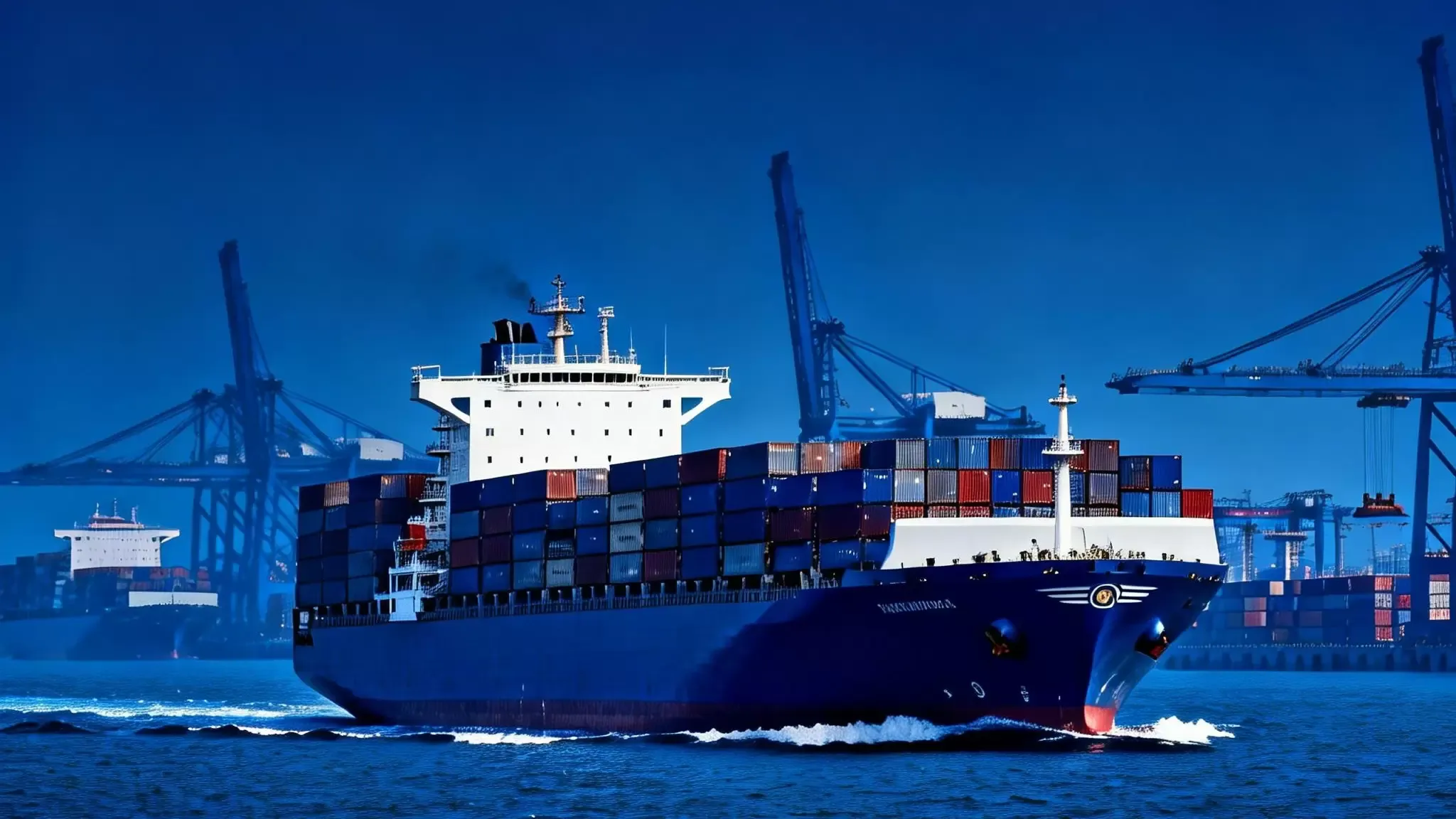
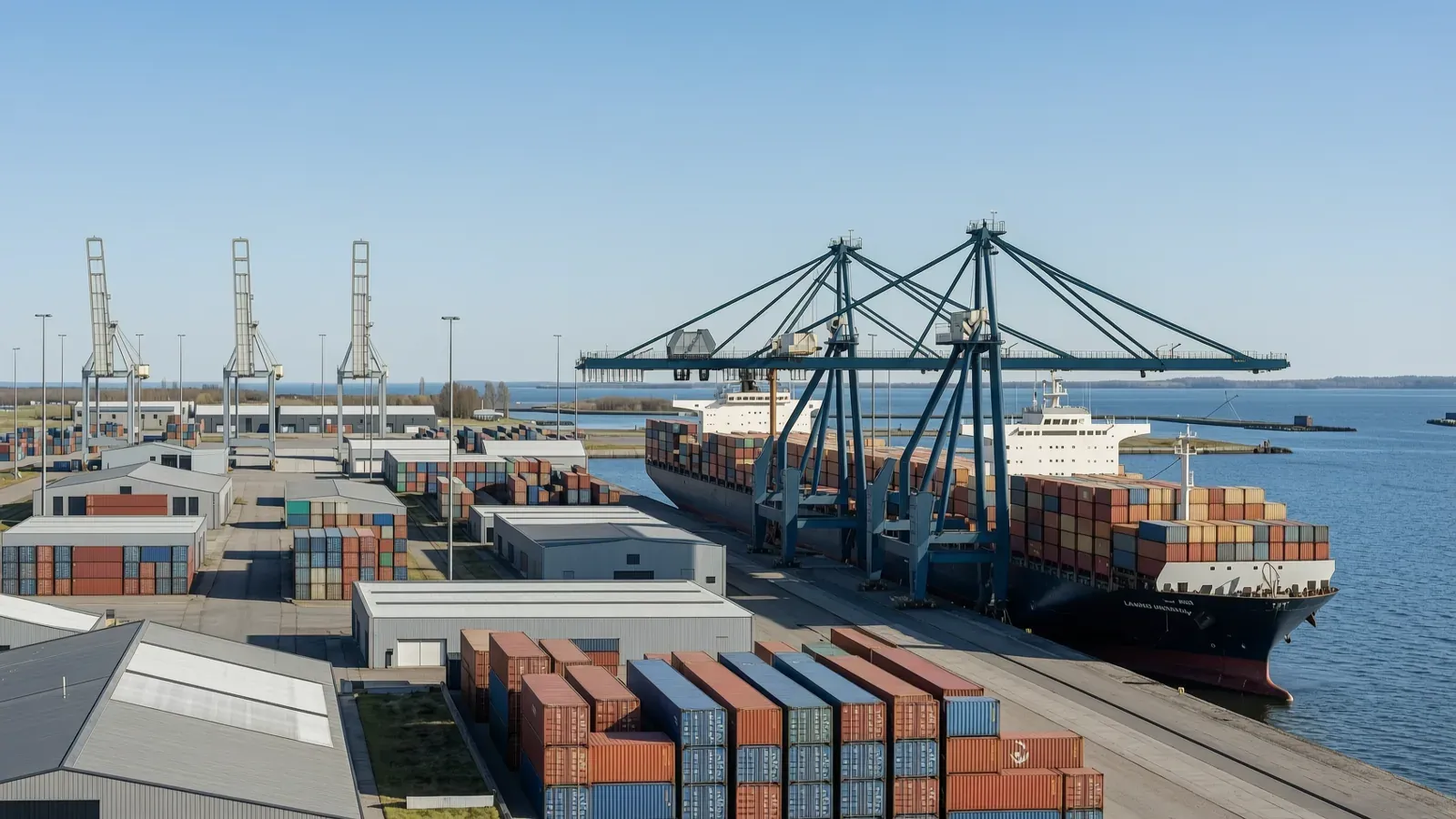
Sea freight from China to Denmark is the default for anything above roughly 15 CBM: furniture, machinery, building materials, textiles, vehicle parts, solar equipment and full production runs. Services leave Shanghai, Ningbo, Shenzhen, Qingdao and Xiamen and reach the Danish coast in four to six weeks, either by a direct call at Aarhus or through a northern European hub.
The detail most rate sheets hide is how much of the cost sits at the destination. Danish terminal handling, documentation and inland delivery are expensive, and a container discharged in Hamburg and trucked north pays German as well as Danish fees. A slightly higher direct rate to Aarhus frequently beats a cheaper feeder routing once those charges and the extra week are counted.
When to Choose Sea Freight
- Your shipment exceeds 15 CBM or 2 tonnes and cost per unit matters more than speed
- A five to seven week door-to-door window fits your inventory plan
- You need a full container, a shared LCL slot, or RoRo capacity for vehicles and machinery
- The goods are non-perishable and tolerate a northern European winter crossing
Typical cargo on this lane: furniture and home goods, industrial machinery and spare parts, building materials, textiles and apparel, automotive parts, solar modules and batteries (subject to carrier dangerous goods rules), and project cargo.
Sea, rail and air from China to Denmark
| Factor | Sea Freight | Rail + Road | Air Freight |
|---|
| Transit time | 28–40 days | 22–30 days | 3–6 days |
|---|
| Cost per kg | Lowest | Medium | Highest |
|---|
| Capacity | Container scale | Container scale | Up to a few tonnes |
|---|
| Best for | Volume and heavy goods | Mid-value goods with a deadline | Urgent and high-value goods |
|---|
Key Ports and Routes
China origin ports: Shanghai, Ningbo, Shenzhen (Yantian and Shekou), Guangzhou/Nansha, Qingdao, Tianjin and Xiamen.
Danish destination ports: Aarhus (the largest container port in Denmark), Copenhagen (CMP), Fredericia, Esbjerg, Aalborg, Odense and Kalundborg. Feeder connections run from Hamburg, Rotterdam, Bremerhaven and Gdansk.
Indicative sea freight transit times, China to Denmark
| Origin port | Danish port | Transit time |
|---|
| Shanghai | Aarhus | 30–38 days |
|---|
| Ningbo | Aarhus | 30–38 days |
|---|
| Shenzhen | Aarhus | 32–40 days |
|---|
| Qingdao | Copenhagen | 32–40 days |
|---|
| Shanghai | Fredericia | 32–40 days |
|---|
| Ningbo | Esbjerg | 33–41 days |
|---|
Add five to eight days when the routing feeds through Hamburg or Rotterdam, and add three to seven days when northern European hubs are congested in the pre-Christmas peak.
FCL, LCL and RoRo
FCL (full container load). A 20ft, 40ft or 40HQ container used exclusively for your cargo. Lowest cost per CBM above roughly 15 CBM, least handling and the lowest damage risk. The standard choice for machinery, furniture sets and repeat orders into Jutland.
LCL (less than container load). Your cargo shares a container and is deconsolidated at an Aarhus or Copenhagen warehouse. Sensible below 15 CBM, but expect a longer door-to-door window and destination charges (CFS, documentation, delivery order) that are high by European standards.
RoRo (roll-on/roll-off). For cars, vans, trucks and self-propelled machinery. Denmark is a small vehicle market, so RoRo sailings are less frequent than into Germany or the UK and should be booked earlier.
Rail and Road From China to Denmark
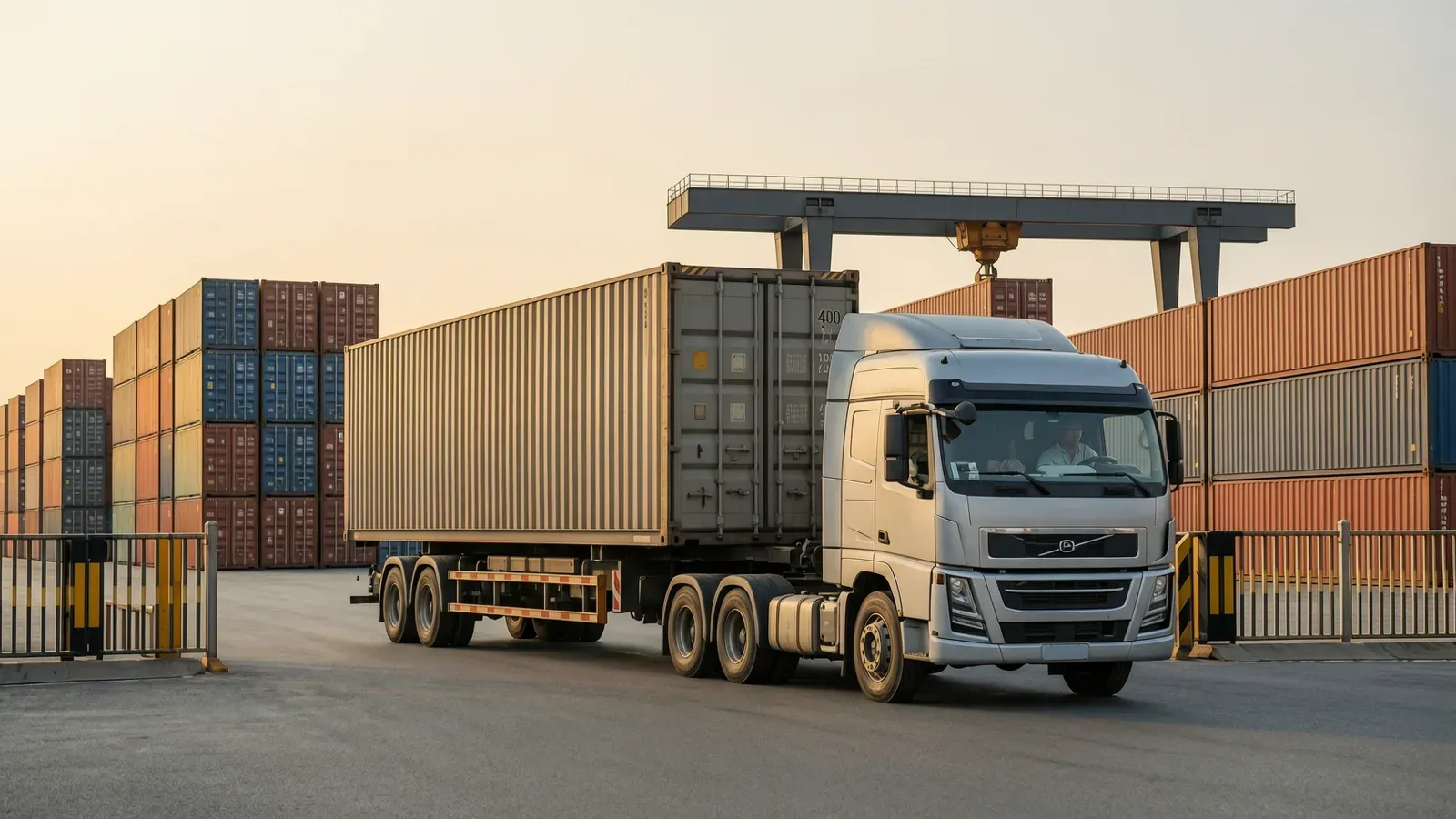
There is no block train that runs from China to Denmark. What exists is a rail leg to a European railhead and a bonded truck for the last 300 to 800 kilometres: trains from Xi’an, Zhengzhou, Chengdu and Yiwu arrive at Duisburg, Hamburg, Tilburg or the Polish border, where your container is transferred to a Danish trailer. Handled as one booking, that combination is the fastest surface option at 22–30 days door to door.
Rail plus road earns its place for mid-value cargo with a deadline: machinery and spare parts, auto components, electronics on pallets, and seasonal goods that cannot wait five weeks on the water but do not justify air freight. The constraint is capacity on the Polish and German railheads in Q3 and Q4, so book three weeks ahead when your delivery date is fixed.
Indicative rail plus road transit times, China to Denmark
| Routing | Transit time door to door | Notes |
|---|
| Xi'an → Duisburg → Aarhus | 22–27 days | Weekly departures |
|---|
| Zhengzhou → Hamburg → Copenhagen | 24–29 days | Bonded truck from Hamburg |
|---|
| Chengdu → Tilburg → Odense | 24–30 days | Tilburg as railhead |
|---|
| Yiwu → Małaszewicze → Jutland | 25–30 days | Polish border transfer |
|---|
Two conditions decide whether rail works: your goods must clear EU customs at the railhead or at the Danish border, and your total volume must justify a container rather than LCL. For a single pallet, air or sea LCL usually wins.
Air Freight From China to Denmark
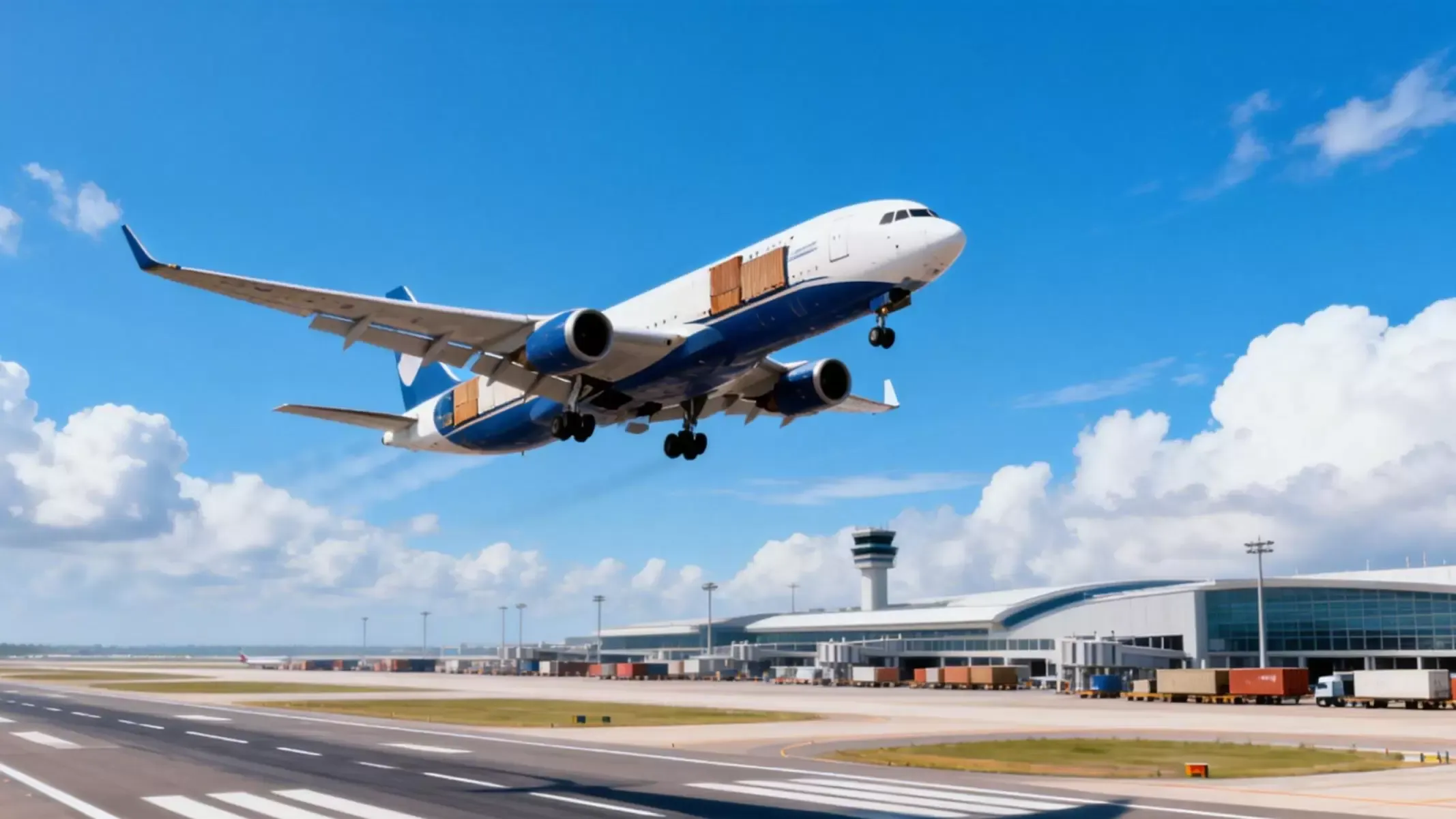
Air freight from China to Denmark is the fastest option and the only sensible one when a shipment is urgent, small or high-value. Copenhagen Airport is the main cargo gateway with direct freighter capacity from Shanghai and frequent belly capacity from Chinese hubs, while Billund serves Jutland and western Denmark.
Air is the right mode when stockout cost exceeds freight cost: electronics, fashion drops, exhibition materials, spare parts for a stopped production line and samples. It is rarely the right mode for furniture or anything above roughly 500 kg that can wait four weeks.
Key Airports and Routes
Chinese airports: Shanghai Pudong (PVG), Guangzhou Baiyun (CAN), Shenzhen Bao’an (SZX), Beijing Capital and Daxing (PEK/PKX), Hong Kong (HKG) and Chengdu Tianfu (TFU).
Danish airports: Copenhagen Kastrup (CPH) carries most international cargo, with Billund (BLL) as a secondary option for Jutland and Funen.
Indicative air freight transit times, China to Denmark
| Route | Transit time | Notes |
|---|
| Shanghai → Copenhagen | 2–4 days | Direct or one stop |
|---|
| Guangzhou → Copenhagen | 3–5 days | Belly capacity dependent |
|---|
| Shenzhen → Copenhagen | 3–5 days | Electronics consolidation |
|---|
| Beijing → Copenhagen | 3–5 days | One stop |
|---|
| Shanghai → Billund | 4–6 days | Via CPH plus road |
|---|
Transit above is airport to airport. Door to door adds pickup, export clearance, import clearance at CPH and inland trucking — plan 3–6 days end to end, and more if the goods need a conformity check.
Door to Door Shipping From China to Denmark
Door-to-door shipping from China to Denmark puts the whole chain under one contract: supplier pickup, export declaration in China, main carriage, EU import clearance, duty and VAT settlement, and delivery to your warehouse or fulfilment centre. For importers without an EU customs department, it is usually the difference between stock that arrives sellable and stock that sits in a bonded warehouse.
What a properly quoted door-to-door service includes:
- Pickup from the supplier, with a check of packing marks and carton counts
- Export clearance and, where applicable, a certificate of origin
- Sea, rail or air main carriage
- Danish import declaration filed by a licensed agent, under your EORI
- Duty and 25 percent VAT settlement, itemized on the customs receipt
- Delivery to the final address, with unloading arranged in advance
Door-to-door process, China to Denmark
| Step | What happens | Owner |
|---|
| Booking | Space, mode and Incoterm confirmed | Efanda |
|---|
| Pickup | Cargo collected and checked at origin | Efanda origin team |
|---|
| Export | Declaration and documents filed in China | Efanda |
|---|
| Main carriage | Sea, rail or air | Carrier |
|---|
| Import clearance | Declaration filed, duty and VAT paid | Danish agent |
|---|
| Delivery | Trucked to the final address | Efanda partner |
|---|
One EU detail decides the design of any DDP shipment: the importer of record must hold an EORI number and be established in the EU, or appoint fiscal representation. A Chinese seller cannot simply declare its own goods and pay the duty at the border. DDP therefore runs through a registered importer-of-record arrangement — your Danish entity, your buyer, or a partner of record that we coordinate — with duty and VAT itemized before the cargo sails.
Shipping Costs From China to Denmark
Shipping costs from China to Denmark are built from four blocks: origin charges (pickup, export declaration, CFS handling), main freight, destination charges (terminal handling, documentation, delivery order, storage) and duty plus VAT. Importer complaints on this lane almost always trace back to comparing only the middle block.
Main freight moves with the market. Northern European rates react to Red Sea routing, fuel surcharges and pre-Christmas capacity within weeks, so treat the ranges below as planning benchmarks, not quotes.
Indicative sea freight cost ranges, China to Denmark, November 2026
| Service | Indicative range | Best for |
|---|
| 20ft FCL | USD 1,700 – 3,000 | 10–28 CBM of dense cargo |
|---|
| 40ft / 40HQ FCL | USD 2,600 – 4,400 | 25–65 CBM, furniture and machinery |
|---|
| LCL | USD 85 – 150 per CBM | 2–15 CBM, test orders |
|---|
| RoRo | Quoted per vehicle | Cars, vans, wheeled machinery |
|---|
Indicative air freight cost ranges, China to Denmark, November 2026
| Shipment size | Indicative range | Typical use |
|---|
| 50–100 kg | USD 6 – 8 per kg | Samples, documents, spare parts |
|---|
| 100–300 kg | USD 5 – 7 per kg | Electronics, apparel restock |
|---|
| 500 kg and above | USD 4.5 – 6 per kg | Commercial cargo, negotiated |
|---|
Rail to a European railhead plus road into Denmark usually prices between sea and air — roughly USD 3,200 – 6,000 for a 40HQ to Aarhus, depending on the season and the trucking distance. All figures are indicative as of November 2026 and exclude duty, VAT and cargo insurance.
Shipping Time From China to Denmark
Shipping time from China to Denmark is a range, and the honest version matters more than the optimistic one. Port-to-port ocean transit runs 28–40 days; door-to-door adds pickup, export clearance, import clearance and inland trucking, so plan five to seven weeks by sea, 22–30 days by rail and road, and about a week by air.
What delays shipments on the China to Denmark lane
| Delay | Typical impact | Where it happens |
|---|
| Feeder connection | 5–8 days | Hamburg, Rotterdam or Gdansk |
|---|
| Pre-Christmas peak | 3–7 days | Northern European hubs |
|---|
| Red Sea diversion | 10–14 days | Asia–Europe mainline |
|---|
| Customs or conformity inspection | 2–5 days | Port or inland clearance |
|---|
| Missing EORI or product registration | Cargo held | Declaration stage |
|---|
| Document mismatch | 2–10 days | Customs review |
|---|
The pattern is consistent: on this lane nobody loses a week because a vessel is slow. They lose it because a registration or a document was missing when the container arrived ready for clearance.
Danish Customs, VAT and Compliance
Customs is where a well-priced shipment becomes an expensive one. Denmark applies the EU customs tariff and, at 25 percent, the highest standard VAT rate in the EU — so the tax stack, not the freight, is usually the largest line on a small shipment.
Duty, VAT and EORI
Duty follows the EU TARIC classification for your HS code and is commonly between 0 and 12 percent of the CIF value. There is no free trade agreement between the EU and China, so Chinese-origin goods pay the most-favoured-nation rate; on some product groups — e-bikes, ceramic tableware, solar glass, certain steel items — anti-dumping duties apply on top and can exceed the base rate several times over.
Duty and VAT on a USD 12,000 CIF shipment into Denmark
| Line | Amount | Note |
|---|
| CIF value (goods + freight + insurance) | USD 12,000 | Customs value |
|---|
| Duty at 4 percent | USD 480 | Rate depends on HS code |
|---|
| VAT base | USD 12,480 | CIF plus duty |
|---|
| VAT at 25 percent | USD 3,120 | Danish standard rate |
|---|
| Total tax paid at import | USD 3,600 | Before freight is counted |
|---|
If your business is VAT-registered in Denmark, import VAT is normally deductible, which turns it into a cash-flow item rather than a cost. Plan for it anyway: the payment falls due before the deduction is refunded. Anti-dumping exposure is the number to check first, because it is the one that cannot be recovered after the fact.
Documents Required for Danish Clearance
Declarations are filed electronically through the EU customs system by a licensed agent, and the safety and security filing (ICS2) must be lodged before arrival.
Standard documents for importing into Denmark
| Document | Purpose | Notes |
|---|
| Commercial invoice | Declares value and terms | Must match HS code and Incoterm |
|---|
| Packing list | Quantity, weight, packaging | Drives inspection and CFS charges |
|---|
| Bill of lading / AWB | Contract of carriage | Original, telex release or sea waybill |
|---|
| EORI number | Identifies the importer | Required before declaration |
|---|
| CE declaration / conformity | Product safety compliance | Regulated product categories |
|---|
| EPR registrations | Packaging, WEEE, batteries | Required before selling |
|---|
| Danish labelling | Consumer information | Mandatory for most retail goods |
|---|
| Insurance certificate | Cargo cover evidence | Recommended on every shipment |
|---|
Regulated categories carry extra work: electrical goods need CE, RoHS and WEEE compliance, batteries need their own producer registration, packaging must be reported to a Danish producer responsibility scheme, chemicals and food-contact materials fall under Danish environmental rules, and food and cosmetics need additional approvals. None of this can be fixed after the container is on the quay.
E-commerce and Fulfilment in Denmark
Denmark has no Amazon marketplace of its own. Danish shoppers buy through Amazon.de, local platforms and brand stores, and most cross-border sellers keep their stock in Germany, Poland or a Danish third-party warehouse. That shapes how you should ship: fewer, larger replenishments into one European hub beat many small parcels.
Two rules caught out most sellers in recent years. First, distance-selling VAT: selling to Danish consumers from abroad can require Danish VAT registration, and marketplaces increasingly handle collection on your behalf — confirm which applies. Second, producer responsibility: packaging, WEEE and battery registrations must exist before the first unit is sold, and marketplaces check for them.
For a Danish-local operation, a third-party warehouse near Aarhus or Copenhagen gives next-day domestic delivery. For a pan-Nordic operation, a single hub in Jutland with road distribution into Norway and Sweden is usually the cheapest design.
Common Mistakes When Shipping From China to Denmark
Most losses on this lane are avoidable, and they repeat in the same patterns across importers of every size.
Frequent mistakes and their impact
| Mistake | What it causes | Typical cost |
|---|
| Choosing the cheapest quote only | Hidden destination and CFS charges | Extra 15–30 percent on the invoice |
|---|
| Ignoring anti-dumping duties | Unexpected duty at clearance | Several times the base duty |
|---|
| No EORI or fiscal representation | Cargo cannot be cleared | Storage from day one |
|---|
| Skipping EPR registrations | Marketplace delisting | Lost sales and retroactive fees |
|---|
| Assuming Incoterms cover clearance | Duty falls to the wrong party | Disputes with supplier or buyer |
|---|
| No cargo insurance | Unrecoverable damage | Full cargo value at risk |
|---|
Three habits prevent almost all of it. First, ask for an all-in door-to-door quote broken into origin, freight, destination and tax, rather than a headline rate. Second, screen the HS code for anti-dumping exposure before you book. Third, get EORI, product conformity and producer responsibility registrations in place weeks before arrival — not when the vessel is in the North Sea.
How to Choose the Right Freight Forwarder
A freight forwarder from China to Denmark should be judged on destination capability, not only on the rate. The failures that hurt importers happen at Aarhus, in the customs agent’s office and at the fulfilment centre door, which is exactly where a cheap online booking platform has no people.
What to check:
- EU customs capability. A licensed agent relationship, an EORI process, and a named contact who can answer a classification or anti-dumping question.
- Mode neutrality. A forwarder who sells only sea will never tell you that rail would have hit your deadline.
- Compliance pre-checks. Anti-dumping screening, CE and EPR readiness reviewed before departure.
- DDP mechanics explained. Who is the importer of record, and how duty and VAT are settled and evidenced.
- Communication during exceptions. The test of a forwarder is what happens when a vessel is rolled or an inspection is ordered.
Why Work With EFANDA Logistics
EFANDA Logistics has handled China-origin freight since 2018 from Shenzhen, and the China–Nordics lane is one of our standing trade routes. We quote sea, rail and air on the same desk, so the recommendation you get is the one that fits your deadline and your margin rather than the one we happen to sell.
EFANDA Logistics on the China to Denmark lane
| Service area | What you get |
|---|
| Sea freight China to Denmark | FCL, LCL and RoRo to Aarhus, Copenhagen, Fredericia and Esbjerg |
|---|
| Rail plus road | Block-train booking to Duisburg, Hamburg and Tilburg with bonded trucking |
|---|
| Air freight China to Denmark | Consolidation and uplifts into CPH and BLL |
|---|
| EU customs | Declaration filing, EORI support, anti-dumping screening, VAT planning |
|---|
| Door-to-door DDP | Importer-of-record arrangement and final delivery |
|---|
| Account management | One advisor, proactive milestone updates |
|---|
If you are comparing routes, ask us for a side-by-side: the same shipment priced by sea, rail and air with realistic transit windows and the landed cost including duty and VAT. That comparison, not a single rate, is what usually decides the right mode — and it is free.