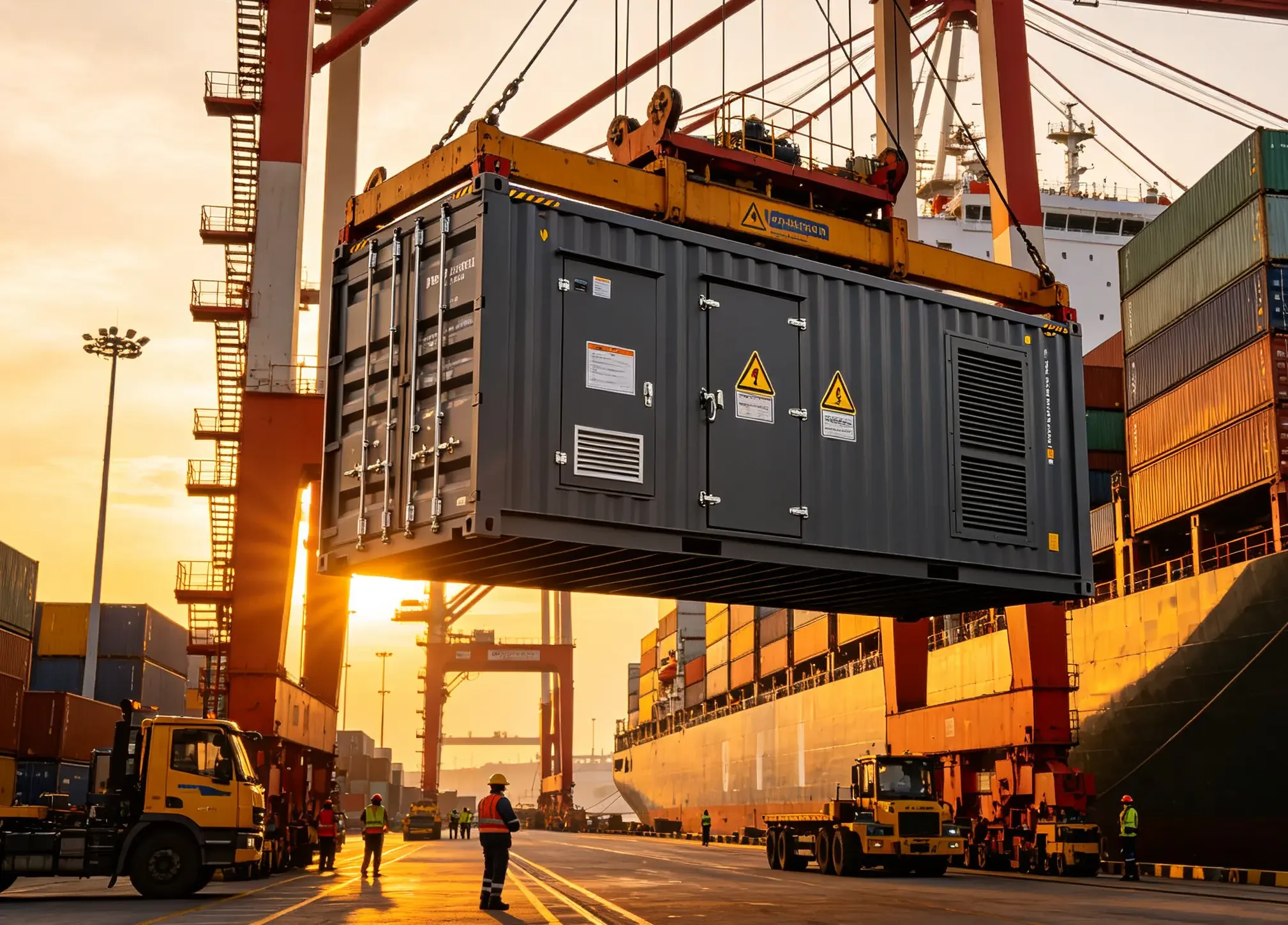
With the global energy transition and the surge in AI data centers, the demand to import BESS (Battery Energy Storage Systems) has hit a record high in 2026. However, figuring out how to ship energy storage systems from China is far more complex than moving ordinary cargo. Because they contain high-capacity lithium batteries, these systems are strictly classified as Class 9 Dangerous Goods (DG). A single misclassified UN number or a missing certification can lead to exorbitant port fines, carrier rejections, or even cargo seizures.
Whether you are importing a 20ft unit for a solar farm in Texas or a 40HQ destined for Europe, navigating the logistics requires specialized expertise. Opting for reliable door to door shipping from china can significantly simplify this process. Below, we cover the 2026 compliance rules that actually affect your shipment (including the mandatory IMDG Code 42-24), what it really costs, and how to get through customs without surprises.
1. Dangerous Goods Classification: Shipping BESS (Battery Energy Storage Systems) from China
Before you book a container, you need to know exactly what you are shipping. Lithium-ion cells pack a massive amount of energy into a compact space. If damaged or short-circuited, they can enter thermal runaway—a severe fire risk. Consequently, the UN mandates that lithium batteries must be shipped under Class 9 Dangerous Goods regulations.
However, the mistake we see most often from first-time BESS importers is choosing the wrong UN classification. Here is the critical difference between the core UN numbers:
- UN 3480: Applies to standalone lithium ion batteries (e.g., bare cells, modules, or battery packs shipped without equipment).
- UN 3481: Applies to lithium ion batteries contained in or packed with equipment (e.g., batteries integrated inside an inverter).
- UN 3536: Applies to lithium batteries installed in a cargo transport unit (CTU).
Our Industry Insights
For the vast majority of buyers looking into how to transport commercial energy storage containers from China, UN 3536 is the correct classification. In this scenario, the entire 20ft or 40ft container acts as the product enclosure, integrating battery modules, the Battery Management System (BMS), and fire suppression systems. Misdeclaring a UN 3536 BESS container as UN 3481 is a fast track to getting your shipment rejected at the port of origin.
2. Why is Shipping Lithium Battery Storage Systems from China Stricter in 2026?
The rules changed on January 1, 2026, and they affect every BESS shipment this year. You are now required to comply with the IMDG Code (International Maritime Dangerous Goods) Amendment 42-24, which became mandatory on that date.
Physical and Stowage Limitations
Under the new IMDG 42-24 rules, containerized BESS (UN 3536) is assigned to Stowage Category D. This means these containers must be stowed on-deck only and kept far away from heat sources and living quarters. Because of these strict placement rules, the available space on a vessel for BESS containers is highly limited, making carrier pre-approval harder to secure and causing potential delays during peak seasons.
The State of Charge (SoC) Rule
To mitigate the risk of thermal runaway during a multi-week ocean voyage, major carriers strictly enforce a State of Charge (SoC) limit. Maersk and COSCO both require lithium batteries to be shipped at 30% SoC or less, and they may ask for proof before accepting your booking. Port authority guidance in China varies—Shanghai MSA recommends 20–50%, for example—but the 30% carrier limit is the number that actually determines whether your container gets loaded. We advise clients to discharge to 25–28% before loading, giving a small buffer so a self-discharge drift does not push you over the threshold at inspection.
3. The Compliance Triangle: How to Transport Commercial Energy Storage Containers from China
Moving a multi-ton BESS container across the ocean requires flawless coordination across three pillars: Document Compliance, Physical Compliance, and Customs Compliance.

Document Compliance
Without the correct paperwork, your cargo will not even enter the port gate. The mandatory documents include:ur cargo will not even enter the port gate. The mandatory documents include:
- UN38.3 Certification / Test Summary: This proves the battery design has passed rigorous safety tests (vibration, altitude, thermal cycling, etc.).
- MSDS (Material Safety Data Sheet): Must clearly state the Class 9 classification and the exact UN number in Section 14.
- Dangerous Goods Declaration (DGD): The formal document submitted to the shipping line and maritime authorities declaring the hazardous nature of the goods.
Physical Compliance
The physical container must meet international safety standards:
- UN-Certified Packaging: The outer packaging must bear the Class 9 hazard label and the correct UN number.
- Special Provision 389: Under UN 3536, battery modules must be securely fastened inside the container to prevent any movement, vibration damage, or short circuits during transit.
Customs Compliance
Customs clearance for lithium batteries is a major hurdle at the destination. For example, shipments to the USA often require proof of UL 9540A testing (especially after recent high-profile battery fires), while European destinations demand CE certification.
4. Sea Freight vs Air Freight for Energy Storage Systems: Which to Choose?
When planning your logistics, you might wonder whether to fly or sail your BESS. Given the extreme weight, large dimensions, and hazardous nature of the cargo, the choice is usually straightforward.
Sea Freight (The Standard Choice)
Sea freight from China is the only viable option for commercial and utility-scale energy storage systems.
- FCL container shipping: Most BESS units are shipped as Full Container Loads (FCL). The system is built directly into standard 20ft or 40ft ISO containers.
- OOG / Flat Rack: For exceptionally large or oversized energy storage cabinets that exceed standard dimensions, you may need to use Open Top or Flat Rack containers.
Air Freight (Rare and Expensive)
Air freight from China is strictly governed by IATA DGR regulations. Passenger airlines generally ban Class 9 lithium batteries over a certain watt-hour rating, leaving only specialized cargo planes. Air freight is only used for extremely urgent, small-scale battery packs or prototypes, and the costs are prohibitively high.
5. A Real Breakdown: Cost of Shipping Energy Storage Systems from China
Budgeting for a BESS shipment requires looking beyond the basic ocean freight rate. Because it is a hazardous commodity, the total cost of shipping energy storage systems from China includes several layers of surcharges.
Ocean Freight and DG Surcharges
The base sea freight for a BESS container typically runs 5% to 10% higher than standard cargo. On top of that, carriers impose Class 9 Dangerous Goods (DG) surcharges, which generally add $200 to $500 per container depending on the shipping line, the route, and whether the unit exceeds standard weight limits. During peak season, these surcharges can climb further.
Local Handling Costs in China
Getting the container from the manufacturer to the vessel is a complex operation. If you are sourcing from a battery factory in Dongguan or Huizhou, you will incur local charges for:
- Specialized DG trucking to the port (e.g., Yantian or Shekou).
- Applying for the UN Packaging Performance Certificate.
- Maritime Safety Administration (MSA) declaration fees.
What We See on the Ground
Last month, a client shipping a 40HQ BESS to Rotterdam had their booking rejected two days before vessel closing. The MSDS listed UN 3481 instead of UN 3536—a document fix that took 48 hours, but the original slot was already gone. The shipment sailed a week late on a different vessel. This kind of error is more common than you would expect, even from experienced battery manufacturers racing to meet a delivery deadline. For US-bound shipments, failing to file the ISF (10+2) 24 hours before the vessel is loaded in China will result in a $5,000 penalty per violation by US Customs. Furthermore, if a forwarder incorrectly declares your BESS under a generic HS code to avoid DG scrutiny, the carrier can levy fines ranging from $10,000 to $30,000 depending on the carrier and the severity of the misdeclaration, and the cargo will be impounded.
Marine Cargo Insurance
A single commercial BESS container can be worth hundreds of thousands of dollars. Given the risks of maritime transport—ranging from rough seas to potential battery fires—purchasing comprehensive cargo insurance services is not optional. Carrier liability typically covers only a fraction of your cargo’s actual value, and it offers no protection against the kinds of documentation errors that cause the most expensive delays.
6. Efanda’s Approach: DDP Shipping for Energy Storage Systems from China to Europe/USA
Coordinating multiple vendors—a trucking company in China, a customs broker, and an ocean carrier—is a recipe for delays and miscommunications. This is where an experienced DG freight forwarder in Shenzhen becomes your biggest asset.
At Efanda Logistics, we have been handling battery and BESS cargo since 2018. We provide DDP shipping for energy storage systems from China to Europe/USA, which means we manage the entire end-to-end process: factory pickup, DG packaging, export clearance, ocean freight, destination customs, and final truck delivery to your project site. Because we run this route regularly, we know which carriers have DG space available this week and which documentation issues are most likely to trigger a hold.
Navigating the US Market
The US market is highly lucrative but fraught with compliance hurdles. As of January 1, 2026, Chinese non-EV lithium-ion batteries—including BESS—are subject to a Section 301 tariff of 25% under HTSUS 8507.60, a significant increase from the previous 7.5% rate. Depending on your product configuration, additional duties such as the forced-labor tariff (10–12.5%) and AD/CVD cash deposits may also apply. By utilizing our DDP service, US buyers can lock in a transparent landed cost. We clear customs using our licensed brokers, ensuring that all duties, MP&F, and HMF are calculated upfront with no hidden surprises. For broader logistics strategies on entering this market, refer to our comprehensive guide on Shipping From China to USA.
The European Route
For European destinations, we route shipments through major hubs like Rotterdam or Hamburg. We manage the strict EU customs entry and coordinate specialized heavy-haul trucking for final delivery to solar farms or commercial facilities across the continent.
7. FAQ
Can I ship a BESS with a state of charge (SoC) above 30%?
Technically, some Chinese ports accept up to 50%. In practice, Maersk and COSCO both enforce 30% at booking, and several other carriers have followed suit. We advise clients to discharge to 25–28% before loading—not just to meet the requirement, but because a sealed container sitting in port for a week before departure can drift upward in SoC, and you do not want to fail a spot check at the terminal gate.
How long does it take to ship commercial energy storage containers from China?
For ocean freight, transit times vary by destination. Shipping to the US West Coast (e.g., Long Beach) typically takes 15 to 20 days, while shipping to European ports takes about 30 to 40 days. However, you must add an extra 1 to 2 weeks for DG booking approvals, local MSA declarations, and specialized loading procedures in China.
Do I need a freight forwarder specialized in DG for BESS?
Yes. We have seen standard forwarders book BESS cargo as general freight, only to have the container rejected at the port gate because the DGD was filed under the wrong UN number or the MSDS was missing Section 14 data. A DG-experienced forwarder knows which carriers currently accept UN3536 cargo, how to prepare the documentation set correctly the first time, and what to do when a port inspection flags an issue. That difference routinely saves clients a week or more in avoidable delays.
Conclusion
Successfully importing energy storage systems from China in 2026 hinges on absolute compliance. From classifying your cargo correctly under UN3536 to navigating the stringent IMDG 42-24 stowage rules and paying the exact DG surcharges, there is zero margin for error. None of this is optional, and none of it can be improvised at the port.
But it does not have to be your problem to solve alone.
Partner with Efanda Logistics, your trusted freight forwarding experts in Shenzhen. We specialize in end-to-end DDP shipping solutions for high-value BESS cargo, offering competitive, transparent pricing based on real market conditions. Contact us today to get a customized, risk-free logistics plan for your next energy storage shipment.

Written by the EFANDA Logistics team — a Shenzhen-based freight forwarder established in 2018, moving cargo from China to ports worldwide with end-to-end pickup, consolidation, customs and door delivery.About us