Are you struggling to navigate Nigeria’s 12-year age limit, the VIN Valuation System, and the new 2026 duty reforms when importing and shipping cars from China to Nigeria?
The rules changed significantly in 2026. Effective 1 July 2026, Nigeria’s Fiscal Policy Measures cut the NAC levy, introduced a Green Tax Surcharge based on engine size, and made electric vehicles fully duty-exempt—yet many guides still quote outdated rates. Operating on old assumptions about customs duties and shipping methods can lead to seized vehicles or massive demurrage charges at Lagos ports. In this guide, we’ll walk through the 2026 customs rules and the new tax structure, compare RoRo vs. Container shipping costs honestly, and give you the step-by-step process we use on the China–Nigeria lane to move vehicles safely and profitably.
Key Takeaways
- Strict 12-year age limit: For 2026, the vehicle must be a 2014 model or newer.
- Left-Hand Drive (LHD) only: Right-Hand Drive and conversion vehicles are strictly prohibited.
- 2026 duty reforms (effective 1 July 2026): NAC levy reduced to 5% (used) / 10% (new); a new Green Tax applies by engine size; EVs are fully duty-exempt.
- Mandatory documents: CRIA and SONCAP certificates plus Form M must be obtained before shipping; your duty assessment is finalized via PAAR on arrival.
- Shipping costs: Ocean freight averages $3,500–$4,500 depending on the method (RoRo vs. FCL).
- Total timeline: Budget 8–12 weeks door-to-door, including 35–45 days of sea transit.
2026 Nigeria Customs Regulations for Importing Cars from China

Importing cars into Nigeria in 2026 requires strict adherence to the 12-year age limit, the Left-Hand Drive (LHD) rule, and the automated VIN Valuation System—plus the updated duty structure that took effect on 1 July 2026.
The 12-Year Age Limit and LHD Requirement
The Nigeria Customs Service (NCS) strictly prohibits vehicles older than 12 years from the year of manufacture. For imports in 2026, this means the car must be manufactured in 2014 or later. Critically, customs reads the VIN plate build date, not the advertised model year: a car marketed as a “2014 model” but built in December 2013 can still be flagged, so always verify the exact production date before paying any deposit. Additionally, all imported cars must be Left-Hand Drive (LHD). The importation of Right-Hand Drive vehicles or those converted from RHD to LHD is illegal. In our experience managing West African logistics since 2018, attempting to bypass this rule inevitably results in immediate confiscation at the port and severe financial penalties.
The VIN Valuation System and Your PAAR
The NCS now relies entirely on the Vehicle Identification Number (VIN) Valuation system, eliminating manual duty negotiation and automatically generating standardized import duties based on the car’s make, model, year, and condition. This leaves no room for under-declaration. After your Form M is accepted, customs issues a PAAR (Pre-Arrival Assessment Report)—the official duty assessment for your specific vehicle. Because the system values your car independently of your invoice, the smartest move is to run a preliminary VIN check on the customs portal before finalizing the purchase, so you know the exact duty cost upfront.
Mandatory Certifications: CRIA, SONCAP, and Form M
Before shipping, importers must obtain a Clean Report of Inspection and Analysis (CRIA) and a SONCAP certificate to apply for the mandatory Form M. The CRIA is a pre-shipment inspection confirming the vehicle’s technical specs and roadworthiness. Following this, the Standards Organisation of Nigeria (SON) issues the Conformity Assessment Programme (SONCAP) certificate. Without these verified documents, your Form M application via the Central Bank of Nigeria (CBN) trade portal will be automatically rejected, stalling your entire shipment.
Customs-Approved Marine Insurance
Nigerian customs requires a marine insurance certificate issued by a CBN-recognized Nigerian insurer—policies arranged with foreign or Chinese providers are routinely rejected, and this is one of the most common reasons clearance stalls. Arrange compliant coverage early in the process. For protection during the 40-day ocean transit itself, cargo insurance covering damage, loss, and theft is strongly recommended, especially for high-value SUVs and EVs.
2026 Nigeria Car Import Duty, Taxes & Total Landed Cost
For 2026, total import taxes on a petrol car shipped from China typically amount to 30–40% of the CIF value—while electric vehicles are fully exempt under the new fiscal policy.
Nigeria’s 2026 Duty Structure (Effective 1 July 2026)
The 2026 Fiscal Policy Measures significantly reshaped vehicle import taxes. The NAC levy was cut, a Green Tax Surcharge was introduced by engine displacement, and EVs received a full exemption.
| Charge | Rate | Basis |
|---|---|---|
| Import Duty | 20% | CIF Value (ECOWAS CET) |
| NAC Levy | 5% (used) / 10% (new) | CIF Value |
| Green Tax Surcharge | 0% (<2,000cc) / 2% (2,000–3,999cc) / 4% (≥4,000cc) | CIF Value |
| Surcharge | 7% | Import Duty |
| ETLS Levy | 0.5% | CIF Value |
| CISS | 1% | FOB Value |
| VAT | 7.5% | CIF + Import Duty |
Electric vehicle exemption: Under the 2026 Fiscal Policy Measures, EVs (such as the BYD Atto 3 or Song Plus) are exempt from import duty, NAC levy, and Green Tax—one reason Chinese EV imports to Nigeria are surging.
Disclaimer: Rates reflect the 2026 Fiscal Policy Measures and are subject to change. Your actual assessment is generated by the VIN Valuation System and finalized in the PAAR. Always confirm current rates with your bank, clearing agent, or the NCS before shipping.
Total Landed Cost Example
To see how these charges stack up, here is an illustrative example for a $10,000 used 1.5L petrol sedan shipped from Shenzhen to Lagos:
| Cost Component | Estimated Amount |
|---|---|
| Vehicle price (FOB) | $10,000 |
| Ocean freight + transit insurance | ~$3,800 |
| CIF Lagos (approximate) | ~$13,800 |
| Import duty (20%) | ~$2,760 |
| NAC levy (5%, used) | ~$690 |
| Green Tax (1.5L engine) | $0 |
| Surcharge + ETLS + CISS | ~$360 |
| VAT (7.5%) | ~$1,240 |
| Taxes subtotal | ~$5,050 (≈37% of CIF) |
| THC + clearing + agent fees | $800 – $1,500 |
| Estimated total landed cost | ≈ $19,000 – $20,000 |
This example is illustrative only—actual figures vary with the exchange rate, vehicle valuation, and port charges. The key lesson: always budget from the landed cost, never from the purchase price alone.
RoRo vs. Container: Best Methods for Shipping Cars from China to Nigeria

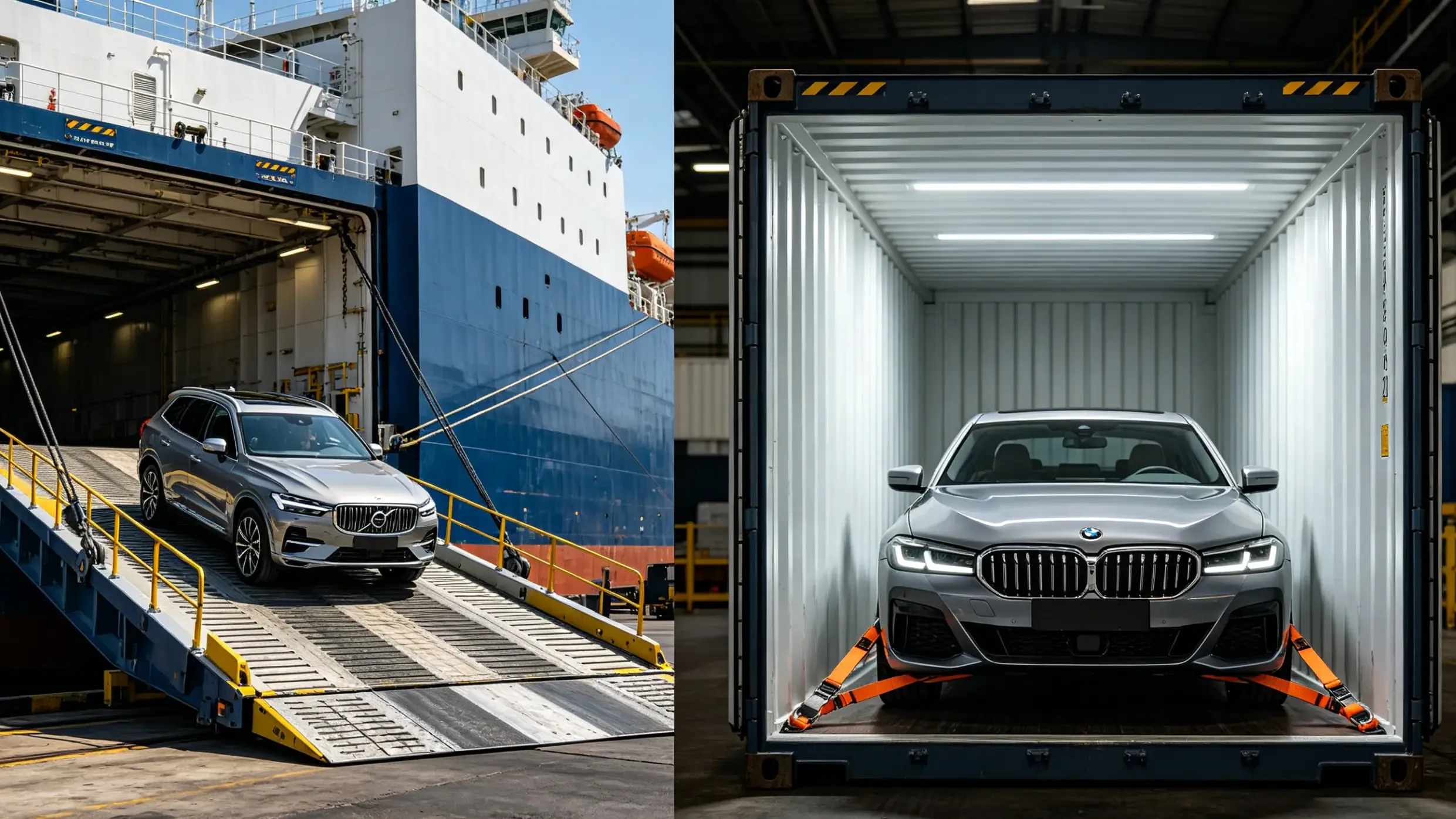
RoRo shipping is typically cheaper and easier for drivable vehicles, while FCL Container shipping offers maximum security and the ability to ship personal goods inside the car.
Roll-on/Roll-off (RoRo) Shipping Explained
RoRo stands for Roll-on/Roll-off. Your car is driven directly onto a specialized cargo ship in China and driven off upon arrival in Lagos. It is generally the most cost-effective way to ship a single, operational vehicle.
Here’s the catch: the car must be fully drivable (not a non-runner), and you are prohibited from packing any personal belongings or spare parts inside the vehicle during transit. For bulk shipments above roughly 10 units, RoRo rates become increasingly attractive.
Full Container Load (FCL) Shipping (20ft & 40ft)
FCL shipping involves loading your vehicle into a dedicated 20ft or 40ft ocean container. A 20ft container comfortably holds one car, while a 40ft high-cube container typically holds two to three cars depending on their size—sharing a 40ft container with other vehicles can reduce the freight cost per car to roughly $1,500–$2,200.
Yes, FCL costs more than RoRo. But you get maximum protection against weather and potential theft, and the container accepts non-runners. You can also pack additional goods or spare parts inside the vehicle and the remaining container space, which RoRo simply won’t allow.
Comparison: RoRo vs. FCL Container Shipping
| Feature | RoRo Shipping | FCL Container Shipping |
|---|---|---|
| Cost | Generally cheaper (~$3,500) | More expensive (~$4,500+ for 20ft) |
| Security | Exposed to elements and handling | High security (sealed container) |
| Personal Items | Not allowed | Allowed inside the vehicle/container |
| Vehicle Condition | Must be drivable | Accepts non-runners and damaged cars |
| Best For | Single running vehicles | High-value cars, non-runners, multiple vehicles |
Cost Analysis & Time Factors for Shipping Cars from China to Nigeria
Shipping a car from China to Nigeria usually runs $3,500–$4,500 in ocean freight, and the full process—from purchase to delivery—takes 8–12 weeks door-to-door.
Disclaimer: Ocean freight rates and customs policies are highly volatile. The costs below are estimates for Q3 2026. Always verify current rates and regulatory updates with your freight forwarder before booking your shipment.
Breakdown of Shipping Rates in 2026

The cost of ocean freight for vehicles fluctuates based on seasonal demand, fuel surcharges, and the chosen shipping line. On average, expect around $3,500 for RoRo shipping and up to $4,500+ for a dedicated 20ft FCL container. These figures cover ocean freight alone and exclude origin port fees in China, destination terminal handling charges (THC) in Nigeria, and the customs duties determined by the VIN Valuation System. For an accurate budget, request a written, itemized quote covering every charge from pickup to delivery.
Transit Time: 8–12 Weeks Door-to-Door

Plan the full timeline in three stages. Stage 1 – pre-shipment: the CRIA inspection and SONCAP certification typically take 2–4 weeks in China. Stage 2 – ocean transit: 35–45 days depending on the port of origin. Stage 3 – clearance: allow 1–2 weeks at Apapa or Tin Can Island once the vessel arrives, assuming paperwork is correct and duties are paid promptly—severe congestion can extend this.
Estimated Transit Times from Major Chinese Ports to Lagos
| Origin Port (China) | Destination Port (Nigeria) | Estimated Transit Time |
|---|---|---|
| Shanghai | Apapa / Tin Can Island | 35 – 40 Days |
| Ningbo | Apapa / Tin Can Island | 35 – 40 Days |
| Shenzhen | Apapa / Tin Can Island | 37 – 42 Days |
| Guangzhou | Apapa / Tin Can Island | 38 – 45 Days |
Buyers in Nigeria’s South-South region can also route through Onne Port (Port Harcourt) as an alternative to Lagos. Whichever port you use, watch the demurrage clock: after the free storage period, terminal charges commonly run around ₦50,000 per day (varying by terminal and vehicle size). That clock is brutal, which is why pre-arrival paperwork discipline matters so much.
Step-by-Step Guide: How to Import and Ship Cars from China to Nigeria

The vehicle import process involves three main phases: sourcing and verifying the vehicle in China, securing pre-shipment inspections and documents, and executing customs clearance in Nigeria.
Step 1: Sourcing and Verifying the Vehicle
Begin by sourcing from reputable Chinese platforms or licensed dealers with verifiable business registration and export experience. Confirm the vehicle meets the 2026 criteria—LHD and a VIN-plate build date in 2014 or later—and request a live video inspection of the actual car (odometer, VIN plate, engine start) rather than relying on photos alone. Run the VIN through the Nigeria Customs portal to pre-estimate duties, and compare the projected landed cost against local Nigerian listings to confirm importing actually saves money.
Step 2: Pre-Shipment Inspection and Documentation
Arrange the CRIA inspection while the car is still in China through a SON-approved agency, then obtain your SONCAP certificate. With these documents, apply for Form M through a CBN-authorized bank, and arrange your marine insurance with a CBN-recognized Nigerian insurer. Only after Form M approval should you authorize your freight forwarder to book the vessel and load the car.
Step 3: Port Arrival and Customs Clearance in Nigeria
When the vessel arrives at Apapa, Tin Can Island, or Onne, the customs clearance process begins. Your clearing agent uses the PAAR to confirm the duty assessment, you pay the duties and taxes through a designated bank, and customs conducts a physical examination to verify the VIN and condition against the paperwork before issuing the final release order.
Common Mistakes to Avoid When Importing Cars from China to Nigeria
Most import disasters trace back to a handful of preventable mistakes. We learned this the hard way: last year we handled a shipment where a first-time importer ignored our VIN check advice, paid for the car upfront, and discovered at Apapa that the build date on the plate read December 2013—one month over the limit. The vehicle was seized on the spot.
The lessons from that case and dozens like it: verify the VIN, use compliant insurance, and budget from the landed cost before sending any money.
- Paying before VIN verification. Never send a deposit without the VIN, a live video inspection, and a preliminary duty estimate.
- Confusing model year with manufacture date. Customs reads the VIN plate—a “2014 model” built in late 2013 is over-age and can be seized.
- Using foreign or Chinese marine insurance. Only CBN-recognized Nigerian insurers are accepted for customs clearance.
- Budgeting from the purchase price. Add freight, 30–40% taxes, port charges, and clearing fees—or the final bill will shock you.
- Leaving items inside a RoRo vehicle. Personal belongings and spare parts are prohibited and can trigger penalties.
- Ignoring the Green Tax when choosing a car. That 4.0L V8 costs an extra 4% of CIF; a sub-2.0L engine pays nothing.
- Relying on verbal clearing estimates. Insist on a written, itemized breakdown from your agent before the vessel departs.
- Using pre-July-2026 duty rates. The NAC levy and Green Tax changed on 1 July 2026—any older figures are outdated.
Why Choose Efanda Logistics for Shipping Cars to Nigeria?
Efanda Logistics handles the entire car shipping process from China to Nigeria—from pickup in Shenzhen to delivery at your door in Lagos—so you don’t have to coordinate five different vendors.
End-to-End DDP Service and Customs Expertise
Honestly, the VIN Valuation System, PAAR processing, and SONCAP certification trip up most first-time importers. Drawing on our operational experience in the China–West Africa trade lane since 2018, Efanda Logistics offers comprehensive Delivered Duty Paid (DDP) solutions. Our dedicated clearing agents at Tin Can Island and Apapa have processed hundreds of vehicles with minimal avoidable demurrage by ensuring paperwork is complete before the vessel even departs. We manage the entire process—from vehicle pickup in China and export documentation to Nigerian customs duties and final door-to-door shipping to your location.
Secure Warehousing and Consolidation in China
If you are buying multiple vehicles or shipping spare parts along with your car, our warehouse services in Shenzhen, Guangzhou, and Yiwu offer the ideal consolidation point. We expertly load and brace your vehicles into FCL containers, protecting them throughout the 40-day journey to Lagos—and our per-car consolidation rates often beat booking a full container alone.
Ready to ship? Request a free, itemized quote from our team and get a transparent landed-cost breakdown before you commit.
Frequently Asked Questions (FAQ)
Can I import an accident car or non-runner from China to Nigeria?
Yes, but non-running vehicles must ship via FCL Container, as RoRo vessels only accept drivable vehicles. The car must still meet the 12-year age limit and LHD requirements.
What happens if my car is older than 12 years?
Frankly, don’t even try. Vehicles over 12 years from the manufacture date face seizure and fines at the port, and individual importers cannot obtain the exemptions sometimes rumored online. Verify the VIN build date before paying any deposit.
How much is the customs duty for cars in Nigeria in 2026?
Duties are calculated automatically by the VIN Valuation System and finalized in your PAAR. As a guide, total taxes on a petrol car typically reach 30–40% of CIF value (20% duty, 5%/10% NAC levy, Green Tax by engine size, plus surcharges and 7.5% VAT). Electric vehicles are fully exempt under the 2026 Fiscal Policy Measures.
Can I import an electric vehicle from China to Nigeria?
Yes—and it is increasingly attractive. EVs are exempt from import duty, NAC levy, and Green Tax in 2026. Confirm battery health, charging compatibility, and software language support before purchase.
Does marine insurance from my Chinese supplier count for customs?
No. Customs requires an insurance certificate from a CBN-recognized Nigerian insurer; foreign or Chinese policies are rejected. Arrange compliant coverage before shipment.
Do I need a clearing agent at Apapa or Tin Can Island?
Here’s the thing: licensed agents understand the VIN system and PAAR processing, and a good agent usually saves more in avoided demurrage than their fee.
How long does customs clearance take at Tin Can Island?
With correct paperwork (SONCAP, Form M, insurance) and prompt duty payment, allow 1–2 weeks, though 3–7 days is possible under ideal conditions without severe congestion.
Can I ship spare parts inside my car using RoRo?
No, and this is one of the rules people forget until it’s too late. RoRo regulations prohibit spare parts, personal belongings, or any extra cargo inside the vehicle. Choose FCL Container shipping if you need to ship extra items.
How long does the whole import process take?
Budget 8–12 weeks door-to-door: 2–4 weeks for pre-shipment inspection and certification, 35–45 days of ocean transit, and 1–2 weeks for customs clearance and delivery.

Written by the EFANDA Logistics team — a Shenzhen-based freight forwarder established in 2018, moving cargo from China to ports worldwide with end-to-end pickup, consolidation, customs and door delivery.About us